Industries

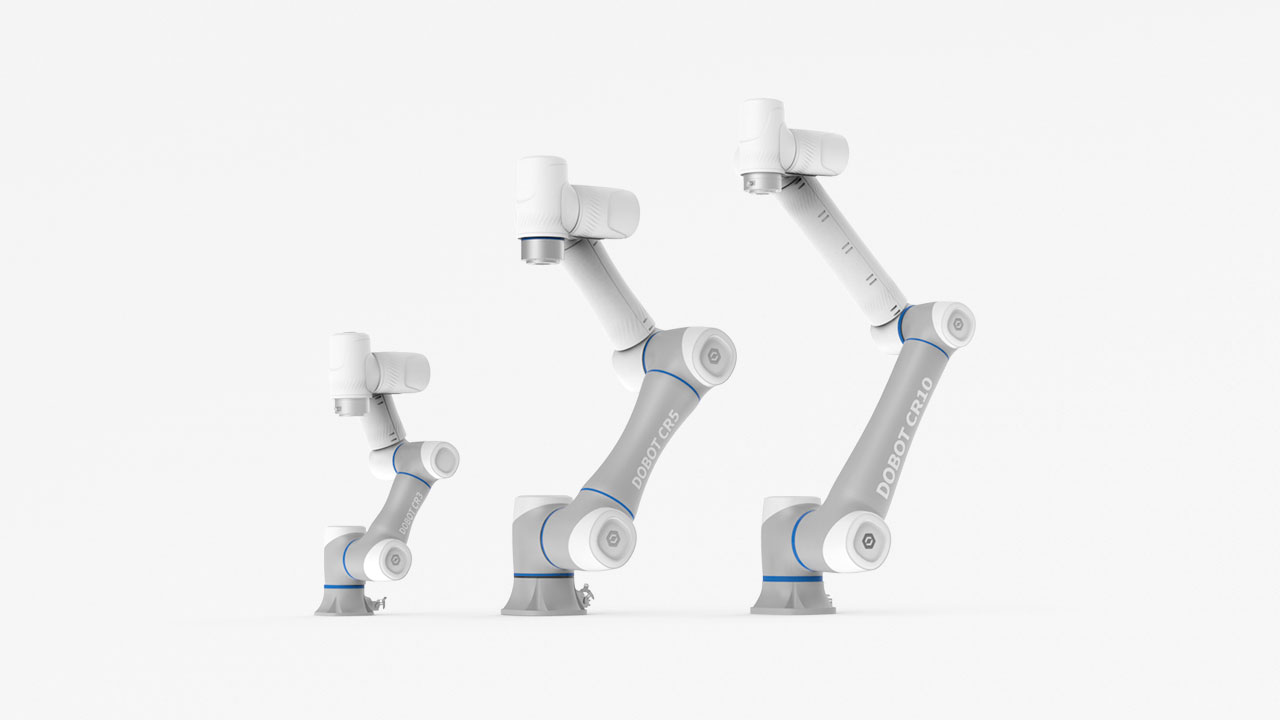
Collaborative robots offer competitive advantages to businesses across industries.
Learn More

Applications

Dobot's robots are capable of performing a wide range of tasks more efficiently.
Learn More
Support

Blog

Providing professional services to meet various customer needs and qualified technical support to answer multiple questions. 

You ask - we answer. 

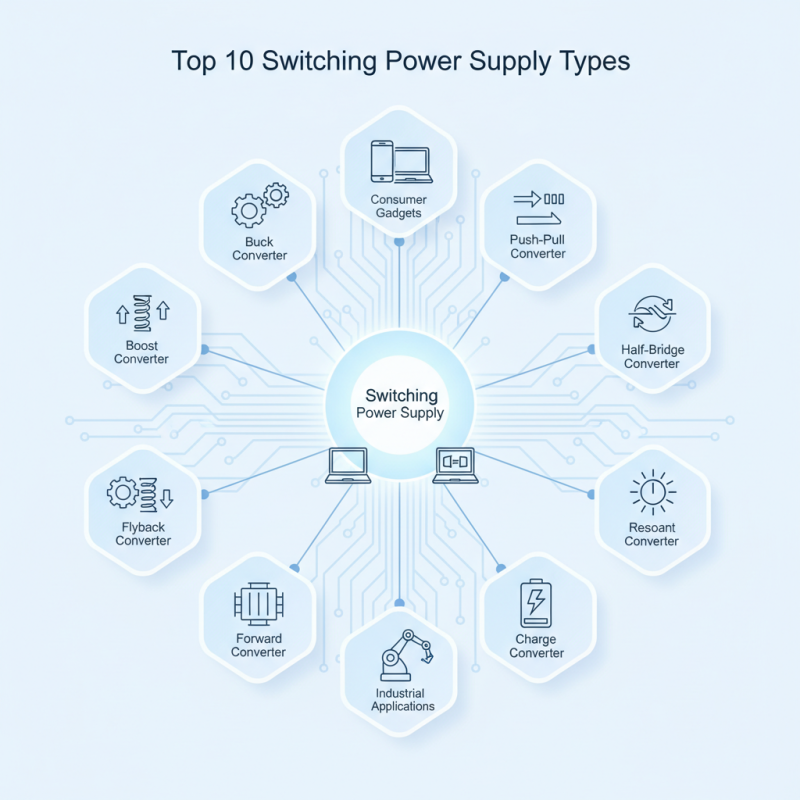
Top 10 Switching Power Supply Types You Should Know?

Switching Power Supply is a vital component in many electronic devices. Understanding its types can help in selecting the right one for your needs. From consumer gadgets to industrial applications, these power supplies are everywhere.

There are various types of Switching Power Supplies. Each type serves a unique purpose and has specific advantages. For instance, some power supplies are more efficient in handling high loads, while others excel in compact designs. However, the complexity can be overwhelming. Users often face challenges in choosing the right type for their unique requirements.

This article will explore the top ten types of Switching Power Supplies. By examining their features, pros, and cons, we aim to provide a clearer picture. Familiarity with these types can lead to better decision-making. It also encourages critical thinking about your electronic needs. Keep in mind that not every option will suit every situation. There’s room for improvement in understanding and application.

Top 10 Switching Power Supply Types You Should Know?

Understanding Switching Power Supplies: A Comprehensive Overview

Switching power supplies (SMPS) are vital in modern electronics. They convert electrical power efficiently. According to a report by the International Energy Agency, up to 80% of all electronic devices use some form of SMPS. This highlights their significance in energy management.

These supplies can reduce energy waste and manage heat better. They operate by switching on and off rapidly, which contributes to their efficiency. Research shows that SMPS can achieve up to 95% efficiency under optimal conditions. However, this efficiency can decline in less-than-ideal scenarios. It's crucial to assess design flaws and component quality, as these can lead to increased noise and ripple effects.

Furthermore, various types of switching power supplies exist, each with unique features. Forward converters, flyback converters, and half-bridge converters are notable examples. Each one serves different applications and has its own set of advantages and drawbacks.

The market dynamics are shifting, with advancements in technology prompting reconsideration of older designs. Staying informed about these changes is essential for practitioners.

Different Types of Switching Power Supplies: Key Characteristics

Switching power supplies are crucial in many electronic devices. They efficiently manage power by converting one voltage level to another. Different types have unique features that suit specific applications. For instance, flyback converters are popular in low to medium power applications. They are simple and cost-effective, often used in chargers and adapters.

Another common type is the forward converter. It offers better performance at higher power levels compared to flyback. However, the design can be more complex. Many designers lean towards resonant converters for high-efficiency needs. These types minimize switching losses significantly, making them ideal for high-frequency applications. According to industry reports, resonant converters can improve efficiency by up to 95% in some cases.

Despite their benefits, switching power supplies can have drawbacks. Electromagnetic interference is a common issue. This can affect nearby sensitive components, leading to operational failures. Addressing this requires careful design considerations. Notably, the thermal management of these devices is another challenge. Poor heat dissipation can reduce lifespan significantly. Understanding these characteristics enhances design quality. It leads to more reliable electronic systems.

Applications of Each Switching Power Supply Type

Switching power supplies are vital in various applications. Each type serves unique functions across different industries. For example, buck converters are commonly used in battery-powered devices. They efficiently lower voltage and extend battery life, making them popular in portable electronics.

Similarly, boost converters increase voltage and are often utilized in LED drivers. These converters ensure a stable light output in display technology. In renewable energy, such as solar panels, they help maximize energy efficiency.

On the other hand, flyback converters are prevalent in high-voltage applications. They provide isolation and voltage regulation, which are crucial in medical and industrial equipment. However, designing these power supplies can be challenging. Engineers must consider the trade-offs between efficiency and cost. The balance is not always easy to achieve.

Advantages and Disadvantages of Common Switching Power Supply Types

When considering switching power supplies, it's essential to weigh their advantages and disadvantages. For example, the most common types include buck converters, boost converters, and flyback converters. Buck converters excel in efficiency and simplicity. They reduce voltage effectively, making them great for battery-powered devices. However, they can generate noise, impacting sensitive circuits.

On the other hand, boost converters increase voltage outputs. They are useful in applications where higher voltage is required. But, they can be less efficient than other types. Flyback converters are versatile and often used in isolated applications. While they offer great flexibility, they might suffer from higher electromagnetic interference. Designers must pay attention to these aspects to avoid poor device performance. Each type has its pros and cons, complicating the selection process. It's a delicate balance, and some might not realize the compromises involved.

Factors to Consider When Choosing a Switching Power Supply Type

When selecting a switching power supply, several factors come into play. Understanding the load requirements is critical. You need to know how much power your device will consume. This requires precise calculations. Oversizing may lead to inefficiency, while undersizing can cause failures. Both choices have their consequences.

Next, consider the input and output voltage. Different applications require different voltage levels. Matching these specifications ensures optimal performance. Additionally, efficiency plays a key role. Higher efficiency reduces energy waste, saving costs over time. Look at the design, too. A compact design might be tempting, but it can affect heat dissipation.

Finally, think about the environment where the power supply will operate. Is it going to be in a dusty area? Or perhaps in extreme temperatures? You need a power supply that can withstand these conditions. Many overlook this aspect, leading to equipment failures. Always remember that a small detail can have a significant impact.

Top 10 Switching Power Supply Types You Should Know

Type Efficiency (%) Typical Applications Key Features
Buck Converter 90 - 95 DC-DC Applications High efficiency, cost-effective, lower voltage output
Boost Converter 85 - 90 Battery-powered devices Increases output voltage, typically simple design
Buck-Boost Converter 85 - 90 Varied voltage input/output Flexible output, handles input voltage above and below output
Flyback Converter 70 - 80 Low power isolated outputs Isolation, simple design, multiple outputs possible
Forward Converter 80 - 88 Mid to high power applications High efficiency, better regulation
Half-Bridge Converter 85 - 90 High power applications Lower component count, high efficiency
Full-Bridge Converter 85 - 92 High power and efficiency needs Ideal for high voltages, good efficiency
Push-Pull Converter 80 - 85 Medium power applications Balanced design, isolation, two output structures
Phase-Shifted Full Bridge 90 - 94 High efficiency needs Minimized transformer size, suitable for high power

User Center Features Promotion

Learn useful insights, save and exchange knowledge easily with MyDobot User Center

Establish Contact with Dobot Experts

Take part in automation transformation. Let’s work together towards a more efficient tomorrow.

Contact Information

Virtual Controller Application

We provide a free trial application for the robot cloud virtual controller. Fill in the following information and we will issue you a 12-hour license.

Contact Information

File sent

The related product information has been sent, please kindly check your email.

Join Dobot+ Ecosystem to Forge Deeper Partnerships

Dobot sincerely invites robotics software companies and hardware manufacturers to Dobot+. Together we can offer best in class solutions to end users in various industries.

Contact Information

Contact Form

Home

Virtual Controller Application

Top